
June 19, 2026
News Release
[Technology development announcement] In a World-First*, TAMRON Successfully Commercializes Highly Heat-resistant Chip-type Metasurface Near-infrared Light Source Utilizing an MIM structure
Tamron Co., Ltd.
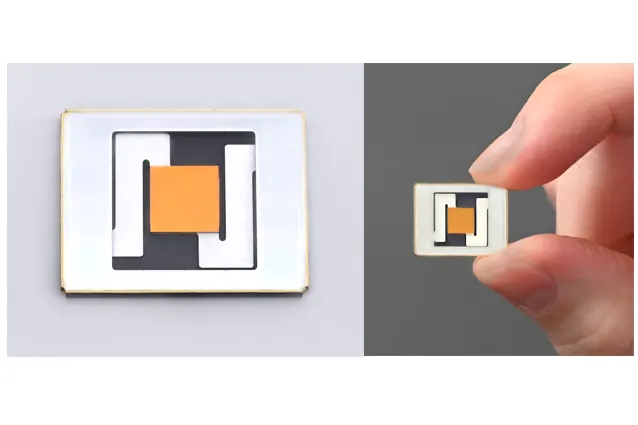
June 19, 2026 – Tamron Co., Ltd. (President & CEO: Shogo Sakuraba; Headquarters: Saitama City, Japan; “TAMRON”), a leading manufacturer of optics for diverse applications, has successfully commercialized an MIM (Metal-Insulator-Metal) metasurface near-infrared light source as a highly heat-resistant chip-type next-generation light source, as part of joint research with Osaka University Professor Junichi Takahara. The achievement marks a world-first*.
TAMRON will give a talk on and exhibit the technology at Infrared Array Sensor Forum 2026 (at Ritsumeikan University Osaka Ibaraki Campus in Ibaraki, Osaka Prefecture), to be held on Friday, July 3, 2026. TAMRON will also begin distributing commercial samples for evaluation from autumn 2026.
Commercialization of the light source will pave the way for turning near-infrared light source equipment for analysis and testing, which has traditionally been bulky and difficult to carry, into innovative portable devices.
Chip-type metasurface near-infrared light source utilizing an MIM structure
Near-infrared light, which allows the non-destructive analysis and testing of a target object's composition and state, has attracted attention in health care and various industrial fields. However, the light sources (lamps, etc.) used in conventional analysis and testing equipment have drawbacks, such as energy losses due to light emissions extending to unnecessary wavelengths. As this generates heat, cooling equipment is needed to remove the heat, increasing the size of the equipment itself to problematic levels.
Addressing this issue as a replacement for these conventional light sources as a next-generation light source for spectroscopic analysis is the metasurface near-infrared light source (wavelength-selective thermal emitter), which utilizes an MIM (metal-insulator-metal) structure.
As this MIM structure is extremely thin and lightweight, yet able to efficiently emit light at the required wavelength, it has the potential to significantly reduce power consumption while decreasing equipment size. However, there was a significant barrier to commercialization: when the high temperature (several hundred degrees Celsius) needed to produce the high emission intensity required is reached, the high temperature would cause various kinds of degradation.
To solve this issue, TAMRON developed a proprietary technology that avoids thermal degradation, by applying the heat treatment and thermal management technologies it has cultivated over many years in the manufacturing of glass-molded lenses, in conjunction with other innovations. As a result, TAMRON was the first in the world to successfully commercialize a next-generation chip-type metasurface near-infrared light source (wavelength-selective thermal emitter) utilizing an MIM (metal-insulator-metal) structure, which is able to withstand an extremely high thermal load.
Being thin and lightweight, the light source features excellent mountability, and as it is able to emit a broad near-infrared wavelength range, it can be equipped in portable non-destructive testing equipment. More specifically, the light source is expected to contribute as a next-generation base technology supporting diverse analysis needs across a wide range of industrial fields, from the measurement of skin condition and blood flow (beauty and health care sectors), the non-destructive measurement of sugar, moisture and fat content, etc. (food, agriculture and fishing sectors), to infrastructure inspection applications such as the diagnosis of structural deterioration in buildings.
TAMRON will pursue its evolution into a comprehensive optical and sensing solution company supplying optical systems and services that integrate advanced sensing technologies with AI and image processing technologies, etc., further refine the optical technologies it has developed since its founding, embody its Long-Term Vision of "Capture, Measure, Connect -- Creating a Healthier Future for People and Nature," and continue aspiring to realize a fulfilling society.
| Emitter Operating Temperature | 400℃-800℃ |
| Device Surface Temperature (emitter locally heated to 500 °C, under weak air cooling) |
50℃ |
| Device Surface Temperature (emitter locally heated to 500 °C, with no cooling) |
85℃ |
| Maximum heat-resistant temperature | 250℃ |
| Power consumption (when emitter is at 500°C) |
1.5W |
| Emitter lifetime (continuous operation with emitter temperature of 50 °C) |
1,000 h or more |
Infrared Array Sensor Forum 2026 website : https://irasf.hacca.jp/
Near-infrared light refers to light at wavelengths of approximately 700–2,500 nm (defined by the JIS standard for near-infrared spectrophotometric analysis) or 750–2,500 nm according to ISO 12099 for near infrared spectrometry guidelines. Near-infrared light easily passes through materials and is readily absorbed by specific components (such as water and organic material). It is mainly used in the analysis of moisture, sugar and fat content, and other substances.
Spectroscopic analysis :
This is an analysis technique that involves exposing a material to light, breaking down the light that is transmitted, reflected or absorbed by wavelength, and investigating the patterns to identify the components in the material and their properties.
MIM (metal-insulator-metal) structure :
A kind of metal metasurface structure that forms a three-layered configuration of metal, insulator and metal as the basic unit.
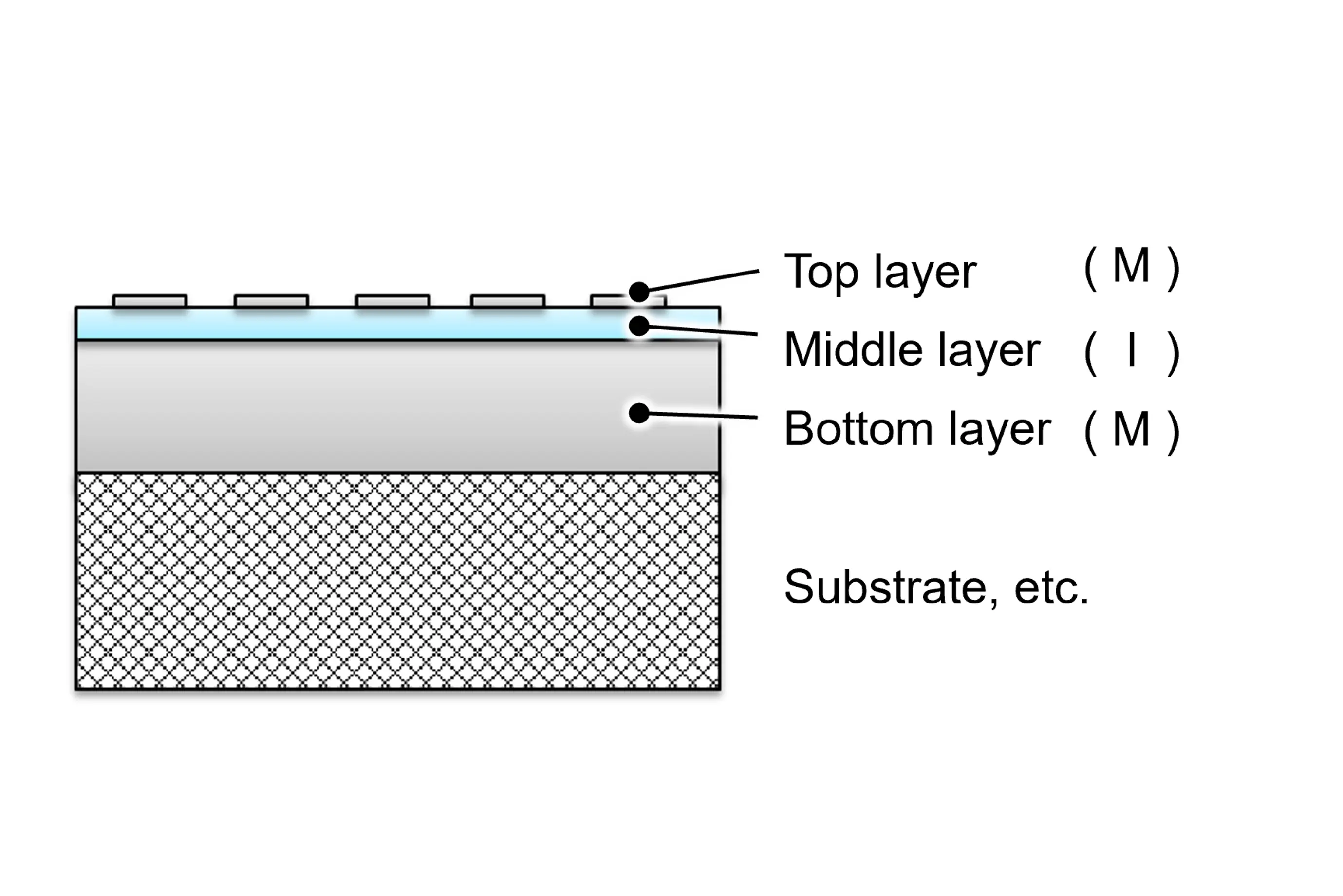
A surface made up of microstructures that are smaller than the wavelength of light, enabling arbitrary control of light and electromagnetic wave properties.
Glass-molded (GM) lens :
A lens created by heating the glass material to a super-high temperature and pressing it into a precision mold fabricated to nanometer-level tolerances. Despite featuring excellent production efficiency, advanced technical expertise is required to manufacture high-precision lenses.